
Science Topics
NEWS
190. Peripheral nerve injury facilitates burst firing of thalamocortical neurons remotely via microglia-dependent enhancement of tonic inhibition
Researcher
Yoshifumi Ueta (Yoshifumi Ueta, Mariko Miyata)
Peripheral nerve injury induces central sensitization, which is hyperexcitability of sensory information processing and underlies the development of neuropathic pain. At the thalamic level, burst firing of thalamocortical (TC) neurons is critical for enhancing neocortical processing of pain information. However, it remains unclear how TC firing changes are triggered by distant peripheral nerve injury. Here, we found, using whole-cell patch-clamp, that peripheral nerve cut induces a hyperpolarized resting membrane potential, decreased input resistance, and downregulation of hyperpolarization-activated cation channels (HCN channels). All of these changes contributed to increasing burst firing occurrence in TC neurons. We also found that enhanced tonic inhibition, that is, persistent chloride influx, via extrasynaptic GABAA receptors, caused these changes in intrinsic properties after peripheral nerve cut. Peripheral nerve cut induces microglial aggregation in the brainstem region receiving injured nerve input. Pharmacological brain-wide microglial ablation prevented peripheral nerve cut-induced changes in intrinsic properties in TC neurons. This technique also prevented peripheral nerve cut-induced enhancement of tonic inhibition in TC neurons. Moreover, local microglial ablation in the brainstem prevented aberrant enhancement of tonic inhibition after peripheral nerve cut. Thus, our results indicate that peripheral nerve cut-induced changes in TC intrinsic properties depend on tonic inhibition, which is further regulated by microglial activity in the brainstem. We propose that microglial and tonic inhibitory interactions along the somatosensory ascending pathway can regulate firing activity of TC neurons after peripheral nerve injury, thereby underlying central sensitization of thalamocortical circuits.
Peripheral nerve injury increases the probability of thalamocortical burst firing remotely via microglia-dependent enhancement of tonic inhibition. Ueta Y, Miyata M. Progress in Neurobiology 262: 102923, 2026.
<Figure Legends>
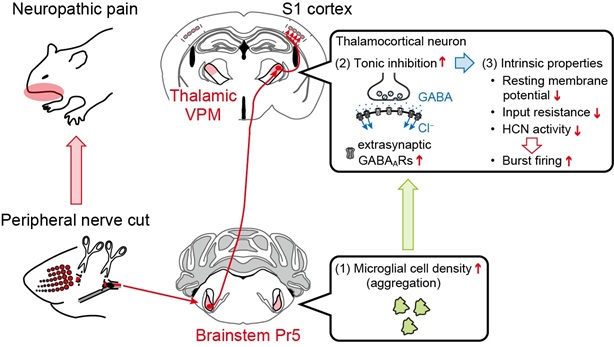
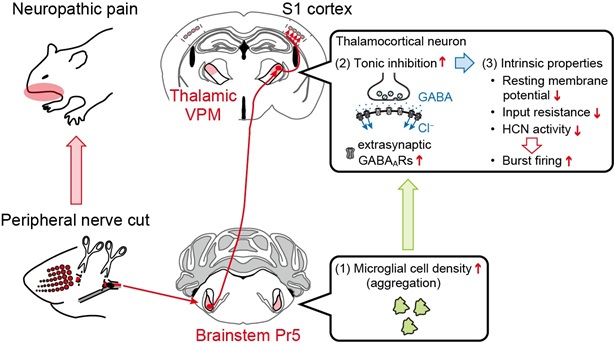
The complete dissection of the infraorbital nerve induces allodynia-like mechanical hypersensitivity in mice. In the mouse somatosensory pathway, tactile information is relayed via the brainstem Pr5 (principal trigeminal) nucleus and the thalamic VPM (ventral posteromedial) nucleus to the neocortical primary somatosensory area (S1). Peripheral nerve cut induces microglial aggregation in the brainstem Pr5. Nerve cut-induced microglial activity is necessary to enhance thalamic tonic inhibition via extrasynaptic GABAA receptors in thalamocortical neurons. Moreover, thalamic tonic inhibition is necessary to induce changes in the intrinsic properties of thalamocortical neurons, thereby increasing the occurrence of thalamocortical bursts. Burst activity of thalamocortical neurons may enhance postsynaptic neocortical excitation, contributing to central sensitization.
Division of Neurophysiology, Department of Physiology, School of Medicine, Tokyo Women’s Medical University, Japan