
Science Topics
NEWS

192. Abnormal motor-limbic crosstalk drives tic generation through the basal ganglia-intralaminar thalamo-insular pathway
Researcher
Hiroto Kuno (Yoshihisa Tachibana)
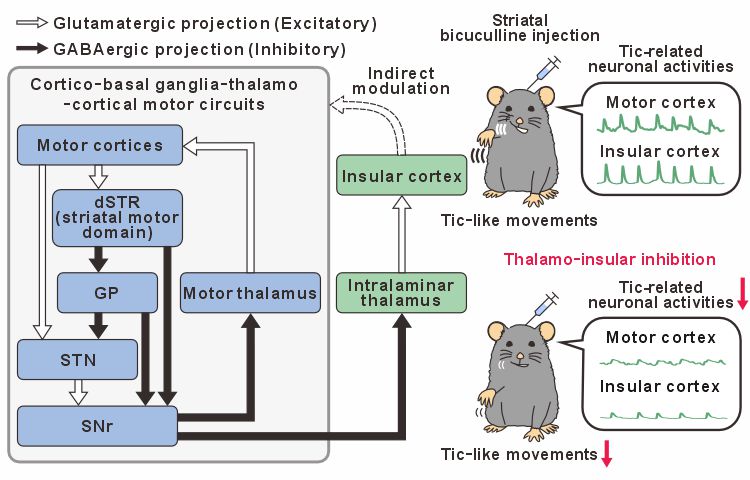
We have demonstrated that the basal ganglia-intralaminar thalamo-insular pathway plays an important role in the generation of tics, using a mouse model that exhibits prominent tic-like movements. Tic disorders are characterized by sudden, repetitive movements (“motor tics”) and vocalizations including inappropriate words or sounds (“vocal tics”). Many patients experience unpleasant sensations that precede tics, known as premonitory urges, and frequently have comorbid psychiatric conditions such as obsessive-compulsive disorder (OCD) and attention-deficit/hyperactivity disorder (ADHD). These clinical features suggest that tic disorders arise from dysfunction beyond motor brain regions. Instead, brain areas involved in uncomfortable internal sensations and emotional processing may also contribute to the pathophysiology of tics. However, the underlying neuronal mechanisms have remained unclear.
Our study revealed that the intralaminar thalamic nuclei connect motor domains of the basal ganglia to the insular cortex, a brain region involved in sensory and emotional processing. We further showed that chemogenetic inhibition of the intralaminar thalamo-insular pathway in the tic mouse model reduced tic-like movements and abnormal neuronal activities associated with tics. These findings provide new insight into the neuronal mechanisms underlying tic disorders and can contribute to the future development of novel therapeutic strategies.
H. Kuno, N. Tsuji, K. Kobayashi, T. Takumi, Y. Tachibana. Intralaminar thalamus relays basal ganglia output to the insular cortex to drive tic generation. Cell Reports. 2026 Apr 22:117272.
DOI: 10.1016/j.celrep.2026.117272.
<Figure Legends>
Cortico-basal ganglia-thalamo-cortical circuits are mostly segregated based on their functions including motor control, learning, motivation, and cognition. In this study, however, we identified a basal ganglia-intralaminar thalamo-insular pathway that bridges different functional domains (left). Using a tic mouse model induced by local bicuculline injection into the striatum, we further showed that chemogenetic inhibition of the thalamo-insular pathway reduced tic-like movements and tic-related abnormal neuronal activities in both the motor and insular cortices (right).
Abbreviations: dSTR, dorsal striatum; GP, globus pallidus; SNr, substantia nigra pars reticulata; STN, subthalamic nucleus.
Department of Health Sciences, Kobe University Graduate School of Medicine, Kobe, Japan